
Shedding light on teaching and learning across education levels - Katarzyna Kubacka, December 09, 2014, OECD
New insights from TALIS 2013: Teaching and learning in primary and upper secondary education reveals
that women constitute more than 65% of the work force on average, in
all six countries that surveyed primary teachers, ranging from 67% in
Mexico to 86% in Poland. In contrast, at least 30% of upper secondary
teachers across all ten surveyed countries are male and the percentage
of female teachers ranges from 48% in Denmark to 68% in Poland.
Pokazywanie postów oznaczonych etykietą OECD. Pokaż wszystkie posty
Pokazywanie postów oznaczonych etykietą OECD. Pokaż wszystkie posty
czwartek, 11 grudnia 2014
niedziela, 7 grudnia 2014
PISA 2012 Technical report
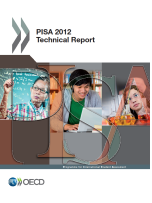
The PISA 2012 Technical Report describes the methodology underlying the PISA 2012 survey, which tested 15-year-olds’ competencies in mathematics, reading and science and, in some countries, problem solving and financial literacy. It examines the design and implementation of the project at a level of detail that allows researchers to understand and replicate the resulting data and analyses. The reader will find a wealth of information on the test and sample design, modes of delivery (paper-based or computer-based), methodologies used to analyse the data, technical features of the project, and quality control mechanisms.
Download the full PDF (15 MB)

czwartek, 20 listopada 2014
Focus No. 45 - Do countries with high mean performance in PISA maintain their lead as students age?
PISA in Focus No. 45 - Do countries with high mean performance in PISA maintain their lead as students age? - PISA in Focus 2014/11 OECD
Countries where 15-year-old students perform at high standards internationally tend to be the same countries where these young adults tend to perform well at the age of 26 to 28.
Countries where 15-year-old students perform at high standards internationally tend to be the same countries where these young adults tend to perform well at the age of 26 to 28.
czwartek, 13 listopada 2014
Under the radar? Professional education and training
Under the radar? Professional education and training -
by Simon Field November 13, 2014, OECD
Skills Beyond Schools Synthesis Report
|
Higher level vocational education and training (VET) programmes are
facing rapid change and intensifying challenges. What type of training
is needed to meet the needs of changing economies? How should the
programmes be funded? How should they be linked to academic and
university programmes? How can employers and unions be engaged? This
report synthesises the findings of the series of country reports done
on skills beyond school.
|

środa, 29 października 2014
Who Are the Doctorate Holders and where Do Their Qualifications Lead Them?
Who Are the Doctorate Holders and where Do Their Qualifications Lead Them?
Many countries have implemented reforms to develop and support doctoral studies and postdoctoral research, stressing the crucial role of doctorate students and degree holders in terms of economic growth, innovation and scientific research.
Many countries have implemented reforms to develop and support doctoral studies and postdoctoral research, stressing the crucial role of doctorate students and degree holders in terms of economic growth, innovation and scientific research.
sobota, 4 października 2014
Delivering feedback for better teaching
Delivering feedback for better teaching -
by Katarzyna Kubacka, Friday, October 03, 2014, OECD
October 5 marks the 20th anniversary of UNESCO’s World Teachers' Day, a day devoted to “appreciating, assessing and improving educators of the world”. This gives us a great opportunity to reflect again on how schools can celebrate and develop great teaching. One way to do that is through critical exchanges – building constructive feedback systems within the schools.
October 5 marks the 20th anniversary of UNESCO’s World Teachers' Day, a day devoted to “appreciating, assessing and improving educators of the world”. This gives us a great opportunity to reflect again on how schools can celebrate and develop great teaching. One way to do that is through critical exchanges – building constructive feedback systems within the schools.
wtorek, 9 września 2014
Educational mobility starts to slow in industrialised world, says OECD
09/09/2014 - Access to education continues to expand worldwide but
the socio-economic divisions between tertiary-educated adults and the
rest of society are growing. Governments must do more to ensure that
everyone has the same opportunity to a good education early in life,
according to a new OECD report.
Education at a Glance 2014 says that educational mobility has started to slow down in the industrialised world. The number of people with lower qualifications than their parents is 9% among 55-64 year-olds to 12% among 35-44 year-olds and 16% among 25-34 year-olds.
źródło
Education at a Glance 2014 says that educational mobility has started to slow down in the industrialised world. The number of people with lower qualifications than their parents is 9% among 55-64 year-olds to 12% among 35-44 year-olds and 16% among 25-34 year-olds.
źródło
Education at a Glance 2014: OECD Indicators
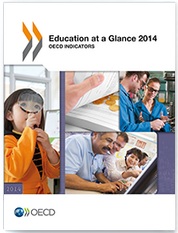
Featuring more than 150 charts, 300 tables, and over 100 000 figures, it provides data on the structure, finances, and performance of education systems in the OECD’s 34 member countries, as well as a number of partner countries.
It results from a long-standing, collaborative effort between OECD governments, the experts and institutions working within the framework of the OECD Indicators of Education Systems (INES) programme and the OECD Secretariat.
źródło
niedziela, 20 lipca 2014
TALIS - The OECD Teaching and Learning International Survey

Click here to browse or purchase the full report "TALIS 2013 Results: An International Perspective on Teaching and Learning"
źródło
czwartek, 17 lipca 2014
Measuring Innovation in Education
 źródło |
Do teachers innovate? Do they try different pedagogical approaches? Are practices within classrooms and educational organisations changing? And to what extent can change be linked to improvements? A measurement agenda is essential to an innovation and improvement strategy in education. Measuring Innovation in Education offers new perspectives on addressing the need for such measurement. |
czwartek, 10 lipca 2014
Nie mają konta, ale potrafią myśleć o finansach. Polacy w ekonomicznej części testów PISA
Nie mają konta, ale potrafią myśleć o finansach. Polacy w ekonomicznej części testów PISA -
Justyna Suchecka
10.07.2014 Gazeta Wyborcza
Choć w gimnazjach nie ma lekcji przedsiębiorczości, a tylko 15 proc. badanych nastolatków ma konto w banku, polscy uczniowie z finansami radzą sobie nieźle.
A ty poradziłbyś sobie z zadaniami dla 15-latków? Mamy pytania z ekonomicznej części badania PISA - js 09.07.2014 GW
Dlaczego do Sary wysłano fakturę? Ile wypłaty dostała pani Joanna? Czy opłaca się kupić 10 kg pomidorów? Taki poziom wiedzy ekonomicznej powinni mieć 15-latkowie. A przynajmniej o to pytano ich w badaniu PISA.
Choć w gimnazjach nie ma lekcji przedsiębiorczości, a tylko 15 proc. badanych nastolatków ma konto w banku, polscy uczniowie z finansami radzą sobie nieźle.
A ty poradziłbyś sobie z zadaniami dla 15-latków? Mamy pytania z ekonomicznej części badania PISA - js 09.07.2014 GW
Dlaczego do Sary wysłano fakturę? Ile wypłaty dostała pani Joanna? Czy opłaca się kupić 10 kg pomidorów? Taki poziom wiedzy ekonomicznej powinni mieć 15-latkowie. A przynajmniej o to pytano ich w badaniu PISA.
czwartek, 26 czerwca 2014
Teachers love their job but feel undervalued, unsupported and unrecognised, says OECD
Teachers love their job but feel undervalued, unsupported and unrecognised, says OECD - 25 June 2014, OECD
Most teachers enjoy their job, despite
feeling unsupported and unrecognised in schools and undervalued by
society at large, according to a new OECD survey.
czwartek, 12 czerwca 2014
Economic Survey of Poland 2014
 Bookshop
 |
Remarks by Mr. Angel Gurría, OECD Secretary-General Press Release in English and in Polish Poland’s overall economic performance has been impressive over the last decade, allowing living standards to converge steadily towards the EU average. Yet, the economy slowed abruptly in 2012-13. Making the labour market work better and strengthening product‑market competition would help foster firms’ competitiveness, overcome strong demographic headwinds and boost both short- and longer-term economic prospects. While substantial progress has been made in these areas since the nineties, important weaknesses are still restraining the country’s economic potential. |
Making the Labour Market Work Better in Poland
Making the Labour Market Work Better in Poland - Hervé Boulhol, OECD, France
Publication Date 04 June 2014
Strengthening Competition in Poland Balázs Égert1, Antoine Goujard OECD, France
Publication Date: 04 June 2014
Publication Date 04 June 2014
ISSN
: 1815-1973 (online)
DOI : 10.1787/18151973
DOI : 10.1787/18151973
Strengthening Competition in Poland Balázs Égert1, Antoine Goujard OECD, France
Publication Date: 04 June 2014
ISSN
: 1815-1973 (online)
DOI
: 10.1787/18151973
czwartek, 3 kwietnia 2014
wtorek, 18 marca 2014
O skuteczności kształcenia i przedsiębiorczości akademickiej
czwartek, 13 marca 2014 - MNiSW
Przedsiębiorczość akademicka i poprawa, dzięki Europejskiemu
Funduszowi Społecznemu, skuteczności kształcenia wyższego pod kątem
potrzeb rynku pracy były głównymi tematami seminarium w Ministerstwie
Infrastruktury i Rozwoju. Podczas spotkania przedstawiono wyniki
projektu badawczego „Umiejętności i kompetencje w zakresie
przedsiębiorczości". W wydarzeniu wziął udział dr hab. Jacek Guliński,
podsekretarz stanu w MNiSW, który przedstawił referat dotyczący tematyki
spotkania.
Umiejętności i kompetencje w zakresie przedsiębiorczości - 13.03.2014
- Raport z badania OECD Umiejętności i kompetencje w zakresie przedsiębiorczości

- Prezentacja eksperta OECD (w języku angielskim) (284 KB)
Subskrybuj:
Posty (Atom)


 Posty
Posty

